
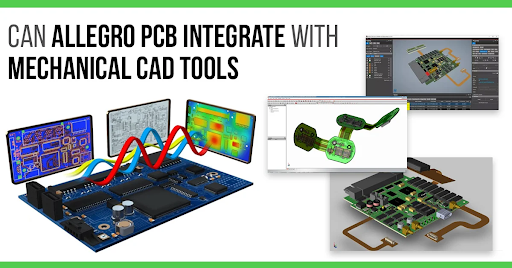
Todays electronics require a close connection between the printed circuit board layout and the casing. If the electrical design and the physical case don’t match, you can spend a lot of money and time on re-designing. So, this is where Allegro PCB shows its advantage. By its integration facilities, PCB designers can work hand in hand with mechanical engineers, thus ensuring that electronic and physical designs are in sync right from the start.
Allegro helps in linking the electrical domain with the mechanical one thus decreasing the likelihood of issues like components not fitting properly, interferences or choked paths which could basically result in production being stopped.
Why Integration Matters in PCB Design
Electronic and mechanical design teams have historically operated independently, with the PCB design team responsible for the routing and placement of components, while the mechanical engineering team has focused on the enclosure casing, mounting, and thermal issues.
However, when these teams work separately, the smallest misalignment can result in the following problems:
- Mechanical interference of the enclosure with PCB components
- Improper connector/heatsink spacing
- Unexpected thermal hotspots
Integrating the PCB and Mechanical CAD applications eliminates these problems. Allegro enables the design data to be exchanged between the CAD applications, enabling the mechanisms for establishing accurate outlines and keep-outs for the PCB and mounting information. This will allow both teams to resolve many issues before manufacturing.
How Allegro Supports Seamless Collaboration
Allegro has built-in support for the most common mechanical CAD formats and allows users to exchange data in both directions between Allegro’s CAD/MID capabilities. Mechanical models can be used to represent mechanical elements of a PCB outline and can help designers by defining cut-outs, mounting holes, and other features. When a mechanical model is updated, the PCB layout is updated automatically by Allegro, thereby eliminating the need for designers to manually update their designs and layout of boards.
By utilizing a Professional PCB service in combination with this capability, the mechanical engineer is better able to visualize all elements of the PCB design. The design team is better able to synchronize the routing and layer stack of the PCB with enclosure mounting locations while still meeting the original design intent. This results in fewer iterations of the design and quicker time to market than if the project had been designed in isolation.
There are several key benefits to using the integrated solution offered by Allegro, including:
- Accurately depict PCB mechanical constraints in PCB layout.
- Develop an entire prototype of the PCB quicker, without additional design errors occurring during the design process.
- Improved communication between the electronic and mechanical product design teams.
Practical Impacts on Production and Reliability
Conjoint PCB and mechanical design workflows lead to greater manufacturability. When the board layout is psychologically coordinated with the mechanical constraints, it will be cheaper and faster to make. Heating, connector position, and the whole enclosure fitting are solved at the beginning level, thus facilitating a more straightforward process from design to assembly.
Moreover, Allegro’s integration functionalities accommodate sophisticated features such as dynamic keep, outs, collision detection, and real, time design changes, which are necessary for high, density or small electronic products.
PCB design and their integration with the appropriate mechanical CAD tools have become mandatory in the design of complex electronic devices. With Allegro PCB, your electrical layout will closely mirror the mechanical PDE, eliminating design conflicts and ensuring reliability. In addition to Sunstream’s PCB design services, you will receive support from Sunstream’s professional engineering team as well as access to the latest technology for high-density multilayer PCBs that are ready for production and can be manufactured and optimized for mechanical specifications in the best manner possible. The result is a faster development cycle, reduced costs and electronic products of high quality, which meet their intended performance specifications with a high degree of accuracy.



 +1.585.935.7123
 +91-804-148-6861