
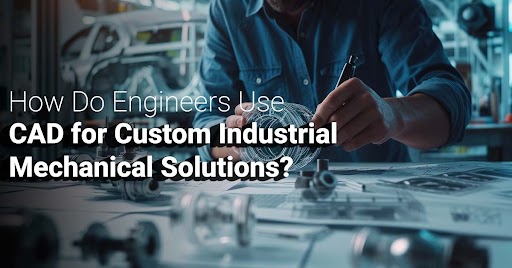
Intensive industrial settings require accurate and flexible mechanical solutions that are customized to fit requirements. To achieve this step-by-step, mechanical engineers are turning to CAD Drafting Services more and more. The CAD software equipment is used broadly in the industry-infused fields for different things ranging from the creation of detailed yet intricate machine assembly to designing specialized tooling. The benefit of the use of CAD is that it enables the team to visualise, simulate and optimise each and every part of the final product well in advance of manufacture. In fact, it is a perfect way to reduce errors, save time and ensure industrial solutions are tailored so that they can be used for specific operational requirements.
In this blog, we will explore the use of CAD by engineers in designing custom mechanical solutions for the industrial sector, covering stages like conceptualizing, simulation, documentation, and production readiness.
From Concept to 3D Modelling
The actions translate requirements into sketches and models. Computer-aided design software opens up an arena of possibilities for engineers in making extremely detailed models that portray different aspects of their designs. The digital models offer great flexibility and are indispensable for working out intricate industrial applications since design changes can be incorporated instantly.
Some of the most significant benefits of using CAD at the conceptual level are:
- Fast development of numerous alternatives of a concept
- Exact portrayal of mechanical movement and joining
- Unambiguous depictions of spatial constraints and interactions
Working directly with 3D models, engineers are able to locate the areas of the design that may cause problems, such as parts that interfere with each other or misalignment. CAD Drafting Services have the skill to foresee such difficulties and solve them prior to the start of production, thus saving a lot of money on revision costs.
Simulation and Performance Analysis
Designing a custom mechanical system that is able to function is one of the most essential points. Computers aided design (CAD) software is a means by which the designers can make the experiments related to the stress, heat production, fluid movement, and vibration.
These experiments confirm the behaviour of the parts, locating the weakest points, and durability enhancement. With this knowledge, engineers refine their choices of materials, sizes, and ways of fixing together parts. Thus, a complex gearbox or an industrial automated machine can be tested in a virtual environment for load distribution, wear, and thermal expansion. Such a step before the actual one guarantees safety, a long life, and energy-saving.
Integration With Embedded Systems
Most modern industrial solutions have smart components that need the coordination of the mechanical design and software control. Engineers often combine mechanical models with Embedded Software to simulate motion, automation, and sensor placement.
- One of the benefits of this integration is the precision with which one can align the mechanical actuators and sensors.
- The efficiency of the timing and control of the automated machinery is another benefit.
- Another important benefit is the very first time detection of the conflicts between software logic and physical constraints.
Sunstream’s methodology is a guarantee that the mechanical and embedded systems will be functioning smoothly; the chances of mistakes during the assembling or the operating phase are very much lowered.
Documentation and Manufacturing Readiness
CAD tools are not limited to 3D designs only; they also create detailed technical drawings, assembly instructions, and parts lists that are required for the production process. These documents verify that each part is made as per the specification, the assembling process is easy, and the maintenance is made simple.
At Sunstream’s engineers use CAD to create:
- Precise production drawings for machinists and fabricators
- A detailed list of materials (BOM) for the supply chain management
- Installation made easy with the help of exploded views and assembly instructions
The capability to produce detailed and accurate documentation is really essential for highly precise industries which can’t lower their standards, like those in the automotive, aerospace, and heavy machinery sectors.
Iterative Design and Continuous Improvement
It is quite common for custom industrial solutions to be developed through several iterations. Computer-Aided Design helps this transition by permitting designers to keep their designs up-to-date, try out new configurations, and make comparisons of the results quickly.
By means of the iterative design:
- The specifications of the client will be absolutely satisfied
- The products will keep their performance standards even if the conditions change.
- The difficulties related to the production will be recognized before they have time to occur
Sunstream’s engineers utilize this iterative feature in their work to keep on refining their solutions and thus be able to present results of high quality every time.
Collaboration and Cross-Disciplinary Efficiency
Modern industrial projects are multidisciplinary teams. One of these technologies, CAD, makes the collaboration among engineers, designers, and software specialists really effective. The entire staff can straightforwardly access the latest versions of the design since the applications are cloud-based and the files are version-controlled. This thus very much reduces the possibilities of the wrong messages being communicated and errors.
Sunstream’s integrated workflow is a very potent cross-discipline collaboration instrument, and it is the mechanical, electrical, and software components of a project, which, by the way, can go from concept to completion, that are the ones aligned.
Digital tools are adopted by engineers for the designing, testing, and upgrading of custom industrial mechanical systems. Basically, they are able to verify the function of the system at a very early stage, modify it in a flash, and resolve the production issues that are still hypothetical. The procedure is a kind of safety guarantee for the equipment that it will run without incidents, in a stable manner and giving the expected results.
At Sunstream, the effect of this is amplified by good workflows and the presence of embedded software development. All these resources together facilitate the manufacturing of mechanical solutions that are not only precise and dependable but also industrially viable right from the first idea through to the last stage of the build.



 +1.585.935.7123
 +91-804-148-6861