
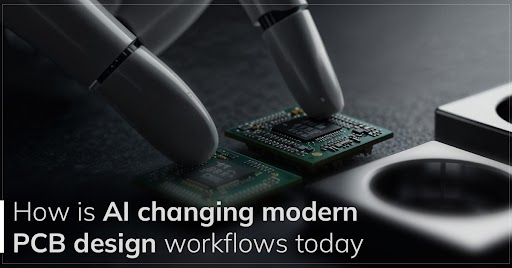
PCB design continues to rapidly evolve as the boards get denser, faster, and more performance oriented. Artificial intelligence is presently taking on a real practical role in assisting engineers to cope with the growing complexity of design without having to extend the development cycles. AI-enabled workflows facilitate making smarter decisions, getting early validation, and having fewer layout revisions. This transformation can be most distinctly seen in high-end setups around Allegro PCB, where the intelligence serves as a tool to complement, rather than substitute, the engineer’s decision-making.
In this blog, we discuss how AI is transforming the workflow of PCB design nowadays, the main points of real value it delivers, and the reason why human expertise still determines the final result.
Moving Beyond Rule Based Design
Traditionally, the design of PCBs (Printed Circuit Boards) has involved using fixed rules and manual checks. This method is successful for some instances; however, it usually does not catch problems until late in the manufacturing process. By contrast, AI (Artificial Intelligence) modifies the way this process happens by automatically learning from previous layout patterns, layout behaviors, and layout feedback from the manufacturing plant.
AI also supports designers by assisting them with the layout phase of PCB designs rather than waiting for problems to occur. This means that AI identifies problem patterns during layout design and provides feedback to the design team on necessary changes prior to any significant design changes due to minor issues.
AI assistance generally provides the following benefits to PCB designers:
- Visibility of spacing and clearance problems occurred early during layout development.
- The ability to detect the congestion of routing optimally during layout.
- The identification of potential problems related to the integrity of signals during layout.
Using AI assistance provides an effective means of eliminating rework and providing realistic timelines for projects.
Smarter Placement and Routing Decisions
Previously, component placement was limited to putting parts into the physical space allowed for a given location. The introduction of AI allows for the consideration of not only thermal paths, power distribution and signals; it considers all of these things simultaneously and recommends a place to put the components that provides the best possible combination of performance and manufacturability.
Routing will also benefit from this capability. An example is when an AI-assisted engine adapts itself to changing constraints and increasing board density of the design, especially with respect to high-speed designs. This capability can be used with standard tools, such as the OrCAD PCB and works naturally with established workflows.
As a result, the design teams can take advantage of:
- Better thermal and power stability in the placement of components, and
- Smarter prioritization of critical nets,
- Less manual trial and error in routing dense designs, and
- Layout results converge faster with fewer corrective passes.
Continuous Verification During Design
AI also changes when verification happens. Instead of waiting until the end, checks are performed continuously as the design evolves.
This ongoing evaluation supports:
- Early identification of EMI and noise risks
- Predictive feedback on manufacturability
- Faster progress toward compliance ready designs
By shifting verification upstream, teams avoid last minute fixes that often affect cost and schedules.
Productivity Without Losing Engineering Control
While AI can improve the speed of tasks, it will not eliminate the need for design ownership – engineers will still be held accountable for their design decisions, with support from AI tools rather than losing control to them as automated authorities.
With AI performing many repetitive tasks such as rule validation, layout comparison, and constraint refinement; designers can devote more time to thinking about system architecture and performance trade-offs than performing these repetitive actions.
In order for organisations to maximise the benefits associated with AI-driven designs the following workflow elements must be included:
- AI-determined insights
- Well-defined engineering intent
- Realisation of fabrication constraints
The synergy of these three components will result in an increase in both quality and speed.
Expertise Still Defines the Result
AI tools are extremely powerful, however, the results really depend on the way they are used. Experienced people are able to interpret suggestions coming from AI and adjust them to the actual situations.
At Sunstream, our PCB design services are a great example of how to combine AI and human expertise. Highly sophisticated software is mixed with carefully engineered steps to finally produce layouts which are not only quite reliable but also easy to manufacture. Teams in Allegro-based environments or those who are developing complex boards with OrCAD PCB Designer are using AI in a very considered way, which helps them make better design decisions from the very beginning.
Combining smart automation with sound engineering judgement allows today’s PCB teams to manufacture improved boards with a higher level of certainty.



 +1.585.935.7123
 +91-804-148-6861